The Anderson Incursion
When We Were F.A.B.

A short break from flogging my book*
I was, and still am, a very big fan of the writer John Wyndham: so much so that for a short time my nickname at school was “John Wyndham.” I’m not alone: Stephen King called him “perhaps the best writer of science fiction that England has ever produced.” Wyndham’s work, firstly in short stories for the pulps and then, after the success of The Day of The Triffids, as the inventor of apocalyptic event fiction, is as much horror as scifi (and is also often very funny – see Pawley’s Peepholes for details).
Wyndham’s work is set in a kind of Festival of Britain of terror: the oceans rise, the monsters gather, the alien stars gleam but his heroes are pipe smokers and his women are reliable in a crisis. His worlds are all very solid (at first). Even the last man from Earth, staring into the Martian night for a glimpse of his smashed home planet, is the quiet, self-reliant sort. I think it was Brian Aldiss who called Wyndham a ‘cosy’ writer: anyone who’s read Dumb Martian or Survival knows that isn’t true. Wyndham is a writer who saw what crawls beneath the skin.
I always wanted to write a story in Wyndham’s world. I can’t write like him, but nothing ventured. So I wrote this story, THE ANDERSON INCURSION, set in his world, and for some reason I based it on a very famous story by William Gibson called THE GERNSBACK CONTINUUM – and I also based it on… well, see for yourself.
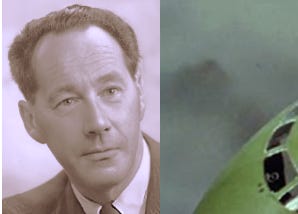
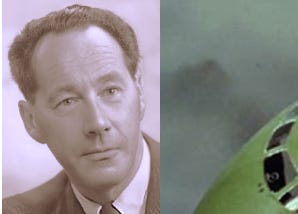
THE ANDERSON INCURSION
I suppose it all began that day in March. Jenny and I were enjoying a day at the beach – just some bottles of beer, the Sunday papers and the kind of sandwich that even the wasps don’t want (Jenny has a trick with ham and tomato sandwiches in particular that seems to transfer all the moisture to the bread) - and I was just about to request the business section so I might turn it into a useful paper hat when Jenny said, “There seems to be a terrible commotion coming from over there.”
Then: “Oh, John! Do something!”
Her voice was so urgent that I at once got to my feet and ran in the direction she was pointing. Jenny ran with me, and soon we were at the site of the disturbance. Some way out to sea – quite a long way, in fact - was a sizeable flat rock. When the tide was out, this rock was popular with children for climbing and even dozing in the sun: assuming a child could get to it across the razor-sharp banks of stone that clustered around it. But when the tide was in, a freak local tide turned the sea around the rock into a vicious whirlpool current that would defeat even the strongest swimmer.
“That poor boy!” cried Jenny.
For there was a child on the rock, a boy of ten or so. He must have climbed the rock, perhaps as part of a game of hide and seek, and been forgotten by his friends. Now the tide was in, and the sea was raging all around him. Judging by the bloody feet of some of the men standing near us, attempts had been made to rescue him without success.
“Wind’s getting up,” said a fisherman with all the stoicism of an onlooker who has nothing to lose.
I could see the boy, waving feebly from the rock as he crouched down. Even from this distance I could see the fear on his face.
I made towards the water but Jenny held my arm.
“I’ve got to try,” I said.
Jenny was about to reply when the air was torn by a metallic shriek. Sand blew in all directions as a huge wind scoured the beach.
“Look!” Jenny shouted, and I looked.
Above our heads was an enormous grey and blue craft. It was shaped like a child’s idea of a space rocket, but it was hovering level with the ground somehow.
“What is that?” Jenny asked.
“Coastguard, I shouldn’t wonder,” said the old salt.
“I don’t think so,” I said, as a hatch opened in the side of the machine and, incredibly, a rope ladder unfurled from inside.
We watched as a figure climbed onto the ladder. It wore a uniform of the same grey and blue as the craft it emerged from, and it – he – reached down a hand to the boy and hauled him up from the rock and onto the ladder.
A moment later, its ladder still dangling alarmingly, the craft began to move towards the shore, still with its curious hovering motion until it was safely over the strand. The ladder lowered itself until it was almost touching the ground. The boy jumped down and ran over to his envious friends, the ladder retreated back inside with its occupant, the craft rose again, and then, with an enormous audible thump, raced off back whence it had come.
“Was that a sonic boom?” I asked Jenny. My wife is something frightfully important in science and knows a lot more about this sort of thing than I do.
“Almost certainly,” she said. “Somehow,” she added, “I don’t think that was the Coastguard.”
It wasn’t. Nor was it the RNLI, the police, the ambulance service, the fire brigade, the Boy’s Brigade or the Dagenham Girl Pipers. Nobody laid claim to it, which only fuelled speculation.
“Russkies, I reckon,” said the old salt as we propped up different parts of the bar the next evening. Jenny was buying, which was fine by me: she earned twice what I did and never stopped mentioning it.
“Why,” asked the landlord, who had flown Hurricanes, “would the Russians be rescuing small boys on our beaches?”
He had a point and the old salt conceded it.
“Aliens, then,” he said.
The landlord snorted. “Very kind-hearted aliens, if you ask me.” he said, with a wink to Jenny and me.
If the first incident was fairly restricted in its audience, the second was anything but. A Canadian Pacific express train from Toronto to Alberta was crossing a river when something on the railroad bridge gave way and the entire centre section of the bridge fell into the water, leaving the front of the train dangling helplessly over the roaring river below.
Attempts to pull the train backward were, needless to say, entirely fruitless, and there was no way to get the passengers out of the train and off the bridge in safety.
The rescue teams were trying to work something out with harnesses and small boats when suddenly there it was, high in the sky above them. Huge, squat and green, like some sort of flying toad, only instead of legs it had small stubby wings which for some reason were facing the wrong way. Whatever it was, it landed on the banks of the river and rose up on impossibly thin legs to reveal a sort of squarish box from which emerged a few seconds later, a kind of tractor-like machine. This device made its way along the bridge, stopped to let a figure in – you’ve guessed it – a grey and blue uniform emerge, attach a magnet to the back of the train (the “caboose,” I believe our Commonwealth cousins call it), and return to the tractor.
Then, the eyewitnesses reported, this small and seemingly not that powerful machine actually dragged the train backwards off the bridge and back onto the land again, detached its magnet and returned to its box. “Like a damned movie being shown backwards,” said one witness. The frog craft squatted down on the box, retrieving it like a kangaroo might a stray baby, and then took off with a deafening roar.
This time the Russkies did claim it. But nobody believed them. Somehow, the Soviet Union being concerned for the well-being of Canadian railway passengers seemed just too unlikely.
Questions were asked in the House but as nobody knew the answers, they were just that: questions. Articles were written, full of speculation and diagrams but empty of facts and information.
“What do you suppose it is?” I asked Jenny one night. She put down her magazine and gave me a look. I knew that look. It meant I was going to be asked something impossible.
“Have you ever heard of the many worlds theory?” she asked.
“No,” I replied, truth being the best policy with my spouse.
“It’s pretty much what the name suggests,” Jenny said. “That there are parallel worlds to this one. And some of us have been speculating that the – intruders – are from another world.”
“You don’t mean Mars, do you?” I said. “Or Neptune or somewhere like that?”
“Whoever they are,” said Jenny, “They’re not Martians or Neptunians, they’re human beings. Terrans, if you like. But they come from a world more advanced than ours, a world that’s the same only different.”
“Maybe they’re from an identical planet on the other side of the sun,” I suggested. “One that we can’t see.”
“Maybe,” Jenny agreed, but she said it in the voice she reserved for telling her employers they were wrong.
The next day Jenny was supposed to be back at seven, but she didn’t come home. Nor was she back at nine, or ten.
At eleven, the telephone rang. It was Peters.
“Hello, Peters,” I said, trying to sound breezy. “I don’t suppose you’ve seen my wife.”
I heard Peters swallow at the other end of the line and a thousand thoughts crowded my mind, none of them pleasant.
“She’s all right,” he said. “For now.”
And before I could ask him what he meant, he said:
“You’d better get here. Quickly.”
Jenny’s place of work is near Salisbury Plain. She works on peaceful applications of military technology, and was currently – so Peters told me as we strode down clinical grey corridors together – trying to see how one of the boffin’s less successful weapons might be diverted to a use that was more ploughshare than sword.
“It’s a kind of plastic explosive called Volaton,” said Peters. “Too lively in its current form, but Jenny was convinced she could make it into something more stable that could be used for demolition jobs.”
I stopped walking.
“You said she was all right,” I reminded Peters.
“She is,” Peters replied. “She was wearing a protective suit when - ”
“When what?” I said, and found I was grabbing Peters’ jacket by the lapels.
Peters swallowed.
“When the floor caved in,” he said.
It seems the lab Jenny was working in was part of a natural network of caves. The pieces of Volaton she was examining had seemed stable until one of them reacted to an element Jenny was trying out.
“What do you mean by ‘reacted’?” I asked.
“It went bang. A big bang but fortunately a big bang in a downward direction,” said Peters. “Jenny was unharmed, but the cave floor collapsed underneath and she fell about ten feet. She’s all right,” he added hastily. “But we can’t get to her through the rubble without disturbing the remaining stick of Volaton.”
“Let me see her,” I said.
“In here,” Peters replied.
‘Here’ was a viewing gallery, suspended over the laboratory and still intact. To my relief and horror, I could see Jenny, sitting on a section of broken floor some twenty feet below. She saw me and waved, putting on a bright smile that neither of us believed in. I waved back.
“What can you do?” I asked.
“At the moment,” Peters replied, “Very little. The engineers are going to try and put supports under the floor, but there’s no way of knowing if it’s safe to do so. The Volaton might react with the air and - ”
He didn’t finish his sentence. He didn’t have to.
Two hours passed, an agony of time in which I was able to signal to Jenny and she to me. It seemed to me that she was becoming tired.
“How much air does she have?” I asked.
“Enough,” Peters answered, “But we can’t be sure of the quality. Those caves go pretty far down and there’s no telling what gases are below us.”
There was a noise. A low whine at first that turned into an intense hum.
“What the - ” Peters began.
Something was coming out of the ground. It was long and narrow at one end, thick the other, like a giant corkscrew.
The cave shook and with it, a piece of something hard and shiny shook too.
“The Volaton!” cried Peters.
And then everything stopped.
I’m still not entirely sure what happened or how it happened, but I remember seeing a figure in a silver suit figure step out of the darkness, presumably from the drilling machine. The figure had in its hands two small blocks of a dark grey material. Peters and I watched in terror as the figure placed the blocks at each end of the stick of Volaton, lifted it up. The blocks did not touch the Volaton, which seemed to hover between them, as if between magnets.
Then the figure turned to looked up at us. I could see glasses underneath the plastic of their helmet, but that was all. It gave a signal that anyone on our world would understand: two thumbs up. And then it walked back to its machine.
Peters and I scrambled down to the lab floor and with no care for safety precautions pulled Jenny out of there. She asked for tea but was given whisky, and after a few hours in the lab’s sick bay, was declared fit to go home.
We never heard nor saw from the intruders again. Whatever rift in time or space that brought them here must have sealed up again.
Jenny is fine now, unaffected by what she persists in calling her grand adventure. True, she has stopped working – for now, she says – but only because of the twins. A fine boy and girl. They’re growing fast and are happiest sitting in a corner with their toys: of which they have, it seems to me, more than enough.
The other day I nearly stepped on one in my stockinged feet, a large green plastic tank of some sort. I bent down and picked it up.
“Jamie,” I said, “You really must be more – ”
I stopped in mid-sentence, and stared at the toy. When Jenny came in with the tea tray two minutes later, I was still standing there. And when she saw what I was holding – not a tank but some sort of aircraft, green and squat like a toad – she dropped the tray.
I’ve tried calling the manufacturers but they don’t seem to understand what it is I want to know. I’ve tried to track down the people who make the television show that features the toys and the people who make the comics that feature the television show but nobody returns my calls.
Jenny says I should leave it and count my blessings.
And most of the time, I agree with her.
DAVID QUANTICK 2026
*IMAGINE A FRIEND, Stars and Sabers £13.99
F.A.B. indeed, David!
And John Wyndham was fab, too!