Free Chapter
This is the way, come inside...

IMAGINE A FRIEND
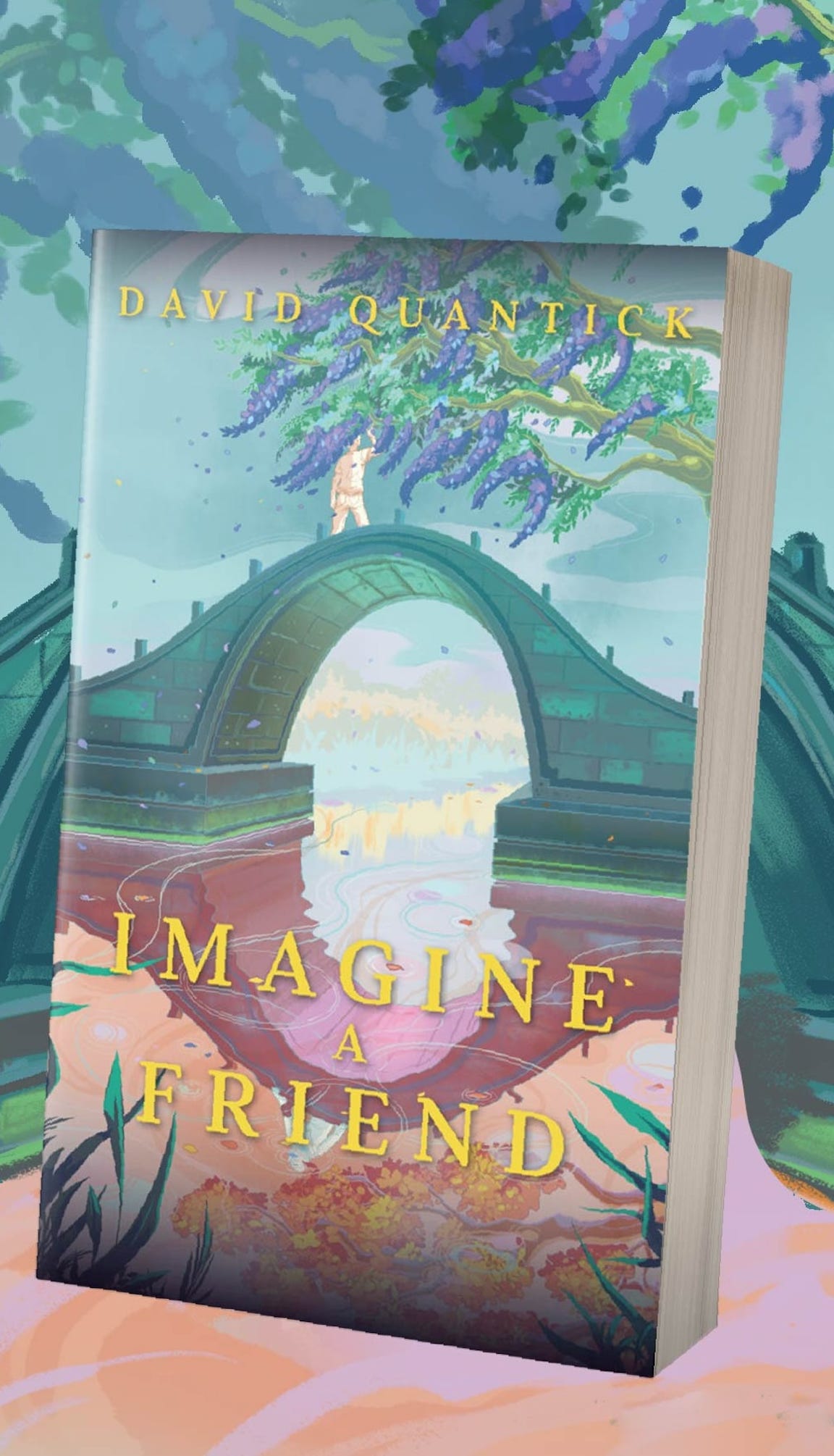
IMAGINE A FRIEND is a novella: a short novel that began life as a film script but found a comfortable home as a book (very special thanks to Stars & Sabers for publishing it). For various reasons, this book means a lot: it may be a fantasy story of sorts but it feels like real life to me.
A while ago, I had this idea for a story about an imaginary friend, a story in which someone finds out a secret about themselves they didn’t know, and this evolved into a story about losing the friendship of someone you love and trying to get them back despite the odds.
Losing a friend is a terrible thing and we all experience it, children and adults alike; sometimes we drift apart from people we were close to: sometimes we’re parted against our will: and sometimes someone just doesn’t want see us any more (on my first day at a new school, my best friend from our old school told me he didn’t want to be friends any more. He never told me why. I think he just wanted to start again: hope so, anyway).
Generally it’s a bad idea to try and rekindle those friendships. But what if it wasn’t that your friend wouldn’t see you any more, it was that they couldn’t see you any more? And what if you never gave up trying to make them see you, even if everyone told you to let it go?
And that’s what IMAGINE A FRIEND is about. Loss, hope, and determination.
Here’s Chapter One:
Imagine a park. A normal kind of park, same as you find in any town—trees and grass, a pond full of ducks and fish, a playground with swings and roundabouts and a sandpit and those weird bouncy elephants on springs—I mean, who puts an elephant on springs? A mad scientist, that’s who—and a river running right through the middle, with a bridge over it.
Imagined it yet? A perfectly normal, regular park.
That’s my park.
My name is Louie and I pretty much grew up in the park. Every day as far back as I can remember I’d wander—or toddle, or possibly even crawl—over the bridge to the playground. I loved the playground, even the bouncy elephants (I mean, seriously, who looks at an elephant and thinks, you know, that would be better with springs on it?).
In fact, my actual first memory is of being in the playground.
I was about three years old. It was a sunny day and all the mums and dads who weren’t queuing up for ice creams were sitting on benches, looking at their phones and every so often looking up and shouting GET DOWN FROM THERE YOU’LL BREAK YOUR NECK at their kids.
Did I mention there was a sandpit? There was a sandpit, and I was in it. At the age of three, I loved sand. I liked to play with it, I liked to play in it and I was even convinced the reason I had sandy hair was because sometimes I liked to eat the sand. And I could not get enough of sandpits. I had my own spade and I would sit there for hours, just digging. I had this thing where I’d dig a hole and I’d roll into it. Then I’d roll out again. And then I’d—well, you get the idea. Roll in, roll out. After a while I got bored with rolling and I stopped. I was covered in sand but that was all right with me, so I just sat there, in the sandpit.
And a moment later, she was there.
I heard a “paf” sound, like something small being plonked down in the sandpit, and I looked up to see a girl. She was my age, she had dark hair, and—more importantly—she had a bucket. She sat there, in the sandpit, trying to fill the bucket with sand. I watched her trying to get the sand into the bucket and I remember thinking, what an amateur.
She must have seen me staring at her, because she looked right back at me. I realised to my horror that she wasn’t looking at me, she was looking at my spade. I clasped the spade to my chest.
She looked at me with pleading eyes.
I shook my head. No way was she getting her hands on my spade.
Her lip started to wobble. A tear formed in her eye. She threw back her head and opened her mouth and—
And I gave her the spade. Just like that. My precious spade, my valuable sand-digging tool: I handed it over to a complete stranger. The girl didn’t hesitate. She may not have heard the expression “never look a gift horse in the mouth” but she understood the basic idea. She began to fill her bucket with sand. I looked on with a professional eye. Her shovelling was sloppy but it got the job done. Seconds later the bucket was filled with sand.
Pleased with her work, she handed me the bucket.
I emptied it over her head. I don’t feel good about that now, but I was three, and I was a boy. The girl sat there, sand in her hair, and looked at me in shock and disbelief. Then she burst into tears. Actually, “burst into tears” doesn’t even begin to describe what happened. She wailed. She howled. Water came out of her eyes in salty explosions. You could see where it hit the sand as it made damp dark craters.
I had done something awful and there was only one way I could make it better. I picked up the spade, filled the bucket and tipped it over my own head.
She stopped crying and began sniffling instead.
I filled the bucket and tipped it over my head again.
She wiped a snot bubble from her face.
I shovelled sand into the bucket until it overflowed and this time I poured it over my head. My hair was full of sand, my ears were full of sand, and there was sand in my eyes and even in my mouth.
The girl stared at me for a moment. Then she began to laugh. And kept laughing. And kept on laughing. Pointing at me, howling with laughter, rocking back and forth on her backside, and laughing. I had never heard anyone laugh as much as she did.
Eventually she stopped laughing, wiped her eyes with her sandy t-shirt, and stuck her hand out. I was confused at first; then I got it and stuck my own hand out.
We shook hands, like generals after a battle.
“Louie,” I said.
“Marcie,” she said.
A hand appeared from nowhere and pulled Marcie to her feet. As she left, I waved at her. She waved back, and she was gone.
After that me and Marcie saw each other all the time. I mean, all the time. In the park at first—although pretty soon we outgrew the sandpit and started playing on more adventurous stuff, like the roundabout (although neither of us was big enough to push the thing at first) and the swings (not just the kiddie swings either, but the real swings, where the teenagers like to sit for hours, not actually swinging). We even went on the bouncy elephants a few times, and I have to tell you, those things have powerful springs: one time I leaned back too far and nearly got catapulted out of the park. (Needless to say, Marcie just laughed and laughed.)
We got bikes and the world was ours. We cycled around the park, first on stabilisers then later on not. We went up and down the streets, yelling and overtaking each other and trying to crash into the back of the ice cream van. Our parents were fine about it, so long as we were both home in time for tea.
We were always together. Sometimes I’d go to Marcie’s and watch cartoons. Sometimes we’d play computer games. But mostly we’d just rush around like crazy people, getting shouted at by grown-ups.
It was the greatest time of my life.
David Quantick 2026
(special thanks to Jendia Gammon and Gareth L. Powell)