And Other (Christmas) Stories 8
What if everyone forgot about Christmas?

This one’s very long but so is the gap between now and New Year…
Happy Christmas!
A DOOR IN DECEMBER
It was a cold day in late December and the Prime Minister had not had a good day. In fact, she had had a terrible day. The Opposition had opposed her, the press had asked her questions she didn’t know the answers to, and the King had given her an enormous list of things that he thought were terrifically important but had no chance of ever happening because kings weren’t in charge these days. Nor, she thought as she skimmed through a long list of emails from her civil servants and her advisors, were Prime Ministers.
Tonight was a typical December night, dark and grey and cheerless, and the streets of London were dark and grey and cheerless to match. Only the street lamps and the lights from the offices along Whitehall illuminated the drive into Downing Street.
“Just here?” asked Consett, her driver. It was his little joke, because they were outside Number 10 Downing Street which, as it was the Prime Minister’s official residence, meant that she was back at the house which had been her home for two and half years now. Being Prime Minister was a bit like being a train, thought the Prime Minister: you went up and down the same tracks all day long until everyone decided you were too old or too rusty and shunted you off to a sidings somewhere.
She sighed as Consett opened the door for her. Once upon a time she had been an idealistic young woman, but now all she wanted to do was get through the day without someone shouting, “Prime Minister! Prime Minister!” at her: which, given that she was the Prime Minister, was extremely unlikely. For a brief moment, she envied the King, whose people tiptoed around him and talked in hushed tones like he was some sort of highly expensive vase that might topple off its pedestal any minute if subjected to noise or sudden movements.
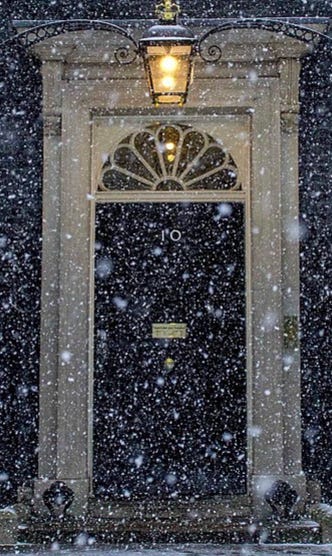
Downing Street was quiet tonight and there were no reporters outside Number 10 as the Prime Minister walked up the steps and nearly walked into the front door. Normally when she went up the steps, someone inside Number 10 was already opening the door for her and all she had to do was step through it. But today the door did not open and the Prime Minister almost walked smack into it. Feeling rather foolish, she was about to knock when the duty constable said:
“Allow me, ma’am.”
And he rapped on the door with his knuckles.
The door didn’t open. Instead a muffled voice from inside said:
“Just a minute.”
A terrible thumping ensued, like someone kicking a dead animal and then the door jerked open inwards. A moment later, a figure appeared, a man in blue overalls.
“Should be all right now,” he said.
Inside Number 10, everything was neat and spotlessly clean except for one small area by the front door which was strewn with tools and tarpaulin and nails and sawdust.
“Thought we’d get it fixed before the New Year holidays,” said an aide, whose name was Pomfrey. “It’s been sticking for months.”
“Has it?” said the Prime Minister. She supposed that one of the drawbacks of never opening a door yourself was that you never knew if there was anything wrong with the door.
“Oh yes,” Pomfrey replied. “It was sticking so we had it looked at and,” he went on, regretfully, “it was clear that all the wood in the door had rotted.”
“All the wood?” asked the Prime Minister.
“Yes,” said Pomfrey. He looked round, as though spies were hanging on his every word (perhaps they were, thought the Prime Minister) “So we had to - ”
He leaned in and whispered.
“What?” said the Prime Minister.
“Yes,” said Pomfrey. “We had to replace the whole door.”
“That was quick,” the Prime Minister said.
“You were abroad,” Pomfrey replied. “And besides we always keep a spare.”
“You do?” asked the Prime Minister, surprised.
“We have to,” answered Pomfrey. “We can’t have Number 10 without a front door. Anyone might walk in.”
“I suppose so,” said the Prime Minister.
“But,” Pomfrey went on, “that door was rotten as well.”
“Oh,” the Prime Minister said. She was both fascinated by and losing interest in the story.
“And then we found this door,” Pomfrey went on.
“What?” said the Prime Minister.
“I know, stroke of luck. And it’s the right size and everything. Apart from a bit at the edge, which as you know, we had sanded down.”
“Where,” the Prime Minister asked, “ was this door?”
“In a shed,” replied Pomfrey. “Next door at Number 11. Where the gardener keeps his tools.”
“Did he tell you about the door?”
“No, he said he’d never seen it in his life. Mind you,” Pomfrey went on, “judging by the state of Number 11’s lawns, he needs his eyes tested.”
They both looked at the door.
“If that’s all,” said Pomfrey, and they parted company.
In the evening the Prime Minister had to attend a ball for the Queen of Sweden. It was a long dull affair and was only improved by the King making “help me” faces at her because he was sitting next to the Queen’s husband, who was very dull. So she was extremely tired when finally she got back to Number 10 – the door worked perfectly – and went to bed.
That night she dreamed she was floating under water. The water was cold and blue and above her head were huge white clouds that she realised were ice floes. She swam to the surface and managed to scramble up onto one of the slabs of ice. Then she looked down at her feet. They weren’t feet anymore, but enormous white paws. She saw her reflection in the clear water: she was a polar bear. Oddly, she wasn’t concerned about this: she had turned into a Prime Minister, after all so why not a polar bear.
All around her were other ice floes and on each floe sat another polar bear. There were polar bears as far as the eye could see, just floating.
And then she saw it. A huge wave, racing across the waters. It was like a moving, rushing wall, higher than the tallest building and roaring like a thousand storms.
She closed her own eyes as the wave crashed towards her. The other bears and their slabs of ice were sent flying into the sky but somehow she managed to hold onto hers as it too was flung across the sea as the water beneath her churned and thundered.
And, just as quickly as it had started, the wave was gone. Now she and her ice floe were floating, calmly and silently, towards a shore. She must have been flung very far by the tidal wave, she thought, because the shore was in fact a sandy beach, bathed in sunlight and surrounded by clear tropical water. In fact, it was so warm now that her ice floe had almost completely melted. She jumped off the remaining lump of ice and paddled to the shore.
It only took her a few minutes walking to realise that the beach was part of a small island, which was almost completely round. In the middle of the island was a tall hill that looked somewhat like a pig’s head. The island was devoid of vegetation except for a small clump of coconut trees near the beach. Seeing the shells of empty coconuts lying on the beach reminded the Prime Minister that she was hungry, and she was about to try and find some intact coconuts when she saw the man.
He was a big man, and he was wearing nothing but a pair of red and white underpants, which exposed his sunburned belly and legs. The man was sweating a great deal as he carried pieces of wood and placed them in a pile on the sand.
“What are you doing?” the Prime Minister heard herself asking.
If the man in underpants felt any surprise at being addressed by a polar bear on a desert island, he didn’t show it. Instead he said:
“What does it look like? I’m making a bonfire.”
And then she woke up.
“It’s fine now,” said Pomfrey as he handed the Prime Minister a red box.
“What is?” she asked.
“The door,” Pomfrey said, as though it was obvious (to be fair, Pomfrey always talked as though everyone instantly knew what he was talking about, even if it was completely incomprehensible.
“Oh,” said the Prime Minister and then, as Pomfrey seemed to be expecting more, “Good.” She wasn’t particularly interested in the door: she had had her fill of it yesterday and besides, she couldn’t stop thinking about her dream. There was something oddly familiar about the man in his underpants on the beach. She thought for a moment of asking Pomfrey to search for images of men in their underpants and decided it was a bad idea.
He handed her a flask of much-needed coffee and opened the door. She stepped outside into the winter sunlight. December, the Prime Minister thought, was an odd month. It never seemed to know what it was actually supposed to be. December could be sunny, it could be wet, sometimes it could even be snowy: but it seemed a purposeless month, sandwiched between Bonfire Night in December and New Year’s Day in January. Of course, there was Christmas Day, the Prime Minister reflected as she got into the car, but that was more of a religious event, like Easter. People enjoyed the day off, many of them – like her parents – would go to the church, but it wasn’t what you’d call a holiday.
“Where to?” Consett asked, which was his other little joke, and without waiting to be told, started the car.
“Wait,” the Prime Minister said.
“What is it, ma’am?” said Consett.
“Why is there - ”
She stopped.
“Nothing,” she said. “I thought I saw something. But there was nothing there.”
“Very good, ma’am,” said Consett who, despite his fondness for bad jokes, was not the kind of man to go round telling people that the Prime Minister had started seeing things.
Which was exactly what had happened. Just as Consett had started the engine, something had caught the Prime Minister’s eye: something attached to the door of Number 10. Something round and green.
I must be tired, thought the Prime Minister, I just hallucinated a wreath.
That night, she had another dream. In this dream, she was walking through the West End of London at night and, even though it was cold, the streets were full of people. The pavements were crowded and the shops were crowded but everyone seemed to be in a good mood. Even more odd, there were lights everywhere. Lights in windows and lights on lamp posts, and lights strung over the road. There were neon animals and electric stars and strings of blazing bulbs and in some shop windows there were even pine trees festooned with lights and shiny decorations.
And everywhere she went, there was a man. He was large, and stout, and dressed in a red outfit with a white trim. Sometimes he had a hat, sometimes he wore glasses, but always he wore a beard. Sometimes he was a picture, sometimes his face was picked out on neon, and quite a few times he was just someone dressed up as him, but wherever the Prime Minister went, there he was.
She recognised him at once, of course. He was the man she’d seen on the beach.
“Can I help you?” asked a voice. It was a young man, dressed in a bizarre green and white costume, with a matching hat that had floppy cloth ears on it.
The Prime Minister gestured at the lines of people queueing up. Some were lining up to buy goods, but others had children and seemed to be waiting to see the man with the beard.
“What are all these people doing?” asked the Prime Minister.
The woman frowned.
“Why,” she replied, “They’re waiting to meet –
But the Prime Minister never got to hear the rest because her alarm clock went off.
That morning she was too busy to think about her dream: to be honest, thinking about dreams wasn’t a very Prime Ministerial thing to do. She could hardly stop a cabinet meeting and interrupt the Chancellor’s long speech about tariffs to tell everyone what weird dreams she had been having lately, could she? Although, as the Chancellor’s speech seemed to be going on for ever, she did feel a strong temptation to do just that.
At last the Chancellor said what he called a few words in conclusion, and turned to the Prime Minister for her reaction.
“Why don’t we,” she found herself saying, “just give it away?”
“I beg your pardon?” the Chancellor replied. He was a red-faced man with a tiny sprig of hair on top of his head, like a tomato.
The Prime Minister hadn’t meant to say that – in fact, she hadn’t meant to say anything at all, but now she had said it, she couldn’t take it back, because then the Cabinet would think there was something wrong with her. So she smiled enigmatically and said nothing.
At least, that was what she thought she was going to do. In reality, she heard herself speak again.
“The surplus,” she said. “The leftover… things.”
“Things?” asked the Home Secretary, in a slightly sarcastic voice. He had, she knew, hated her ever since she got the Prime Minister’s job and he didn’t.
“Yes, things,” she said. “I mean, we have all these goods we haven’t managed to export, all these things we’ve made, computers, and clothes, and food and drink and… and toys.”
She could see the Home Secretary was about to say, “Toys?” in the same voice in which he had said ,“Things?” so she continued:
“Yes, toys. Lots of children won’t have toys this year, will they? And lots of adults won’t have things they need. So maybe we could give some of it away.”
There was a long silence.
“What a marvellous idea,” said the Minister for Employment and Pensions, in a voice which didn’t sound like she thought it was a marvellous idea at all. “But we already have provision for food banks and charity collections - ”
“And financial relief for those who are entitled to claim it,” added the Chancellor.
“Yes, I know all that, I’m the Prime Minister,” said the Prime Minister, “But I meant – we should do something special, given the time of year.”
“The time of year?” said the Home Secretary, more confused than sarcastic, “You mean December? What’s so special about December?”
The Prime Minister didn’t answer, so the Chancellor took the opportunity to make his report on imports of brawn from the Faroe Islands.
“Everything all right?” asked Pomfrey as he opened the door to Number 10. From the look on his face, he had clearly heard all about the Cabinet meeting.
“Fine, thank you,” replied the Prime Minister. She wasn’t fine, but she wasn’t going to tell Pomfrey that. Instead she said:
“What’s that smell?”
Pomfrey looked puzzled, then aggrieved.
“It’s not me,” he said.
“No,” said the Prime Minister, “It’s sort of - ”
She sniffed the air.
“Tangerines and burning wood and cinnamon and chestnuts and pine and wine - ”
“Definitely not me,” said Pomfrey, but the Prime Minister wasn’t listening. She was walking around, still sniffing.
“It’s coming from here,” she said.
Pomfrey looked puzzled.
“The door?” he asked.
“Yes, what do you think?”
Pomfrey wrinkled his nose.
“It just smells of - door – to me,” he said. He looked at the Prime Minister.
“Are you sure you’re all right?” he asked.
The next day when she went out into Downing Street, the door of Number 10 was bright green.
“Must be the light,” said Consett. “Sometimes when the sun strikes my front door, it seems sort of grey instead of blue.”
But he gave her a look in the rear view mirror when he thought she couldn’t see.
When the Prime Minister came back that evening, she said to Pomfrey:
“What’s that?”
“What’s what?”
The Prime Minister frowned.
“That,” she said, pointing at the enormous object taking up half the hall. It was a pine tree, which someone had cut off at the root and put into a large stand. The tree was covered in shiny coloured chains and tiny objects like trumpets and sledges and angels.
Just like in my dream, thought the Prime Minister.
“This?” said Pomfrey. “It’s a hat stand. We thought we’d get a new one. Do you not like it?”
The Prime Minister said nothing. The smell of tangerines and burning wood and all the other things was even stronger now. And she could hear something, too. An insistent jingling, like little bells. She thought of mentioning this to Pomfrey but, seeing his face, decided not to.
The next morning was a very busy one and the Prime Minister barely had time to pick up her flask of coffee as Consett set off for Parliament..
She finished the coffee as she walked into her office and saw with a sinking feeling that her desk was piled high with official boxes.
“A lot to get through today,” said her secretary, apologetically, and handed her something.
The Prime Minister stared at the piece of paper in her hand. It was a letter; no, a list; no, a list and a letter. A letter to someone that listed, for some reason, a lot of things they wanted to be given.
“What is this?” she asked. Her secretary looked puzzled.
“It’s that list you asked for,” he said. “The quotas for car exports next year.”
The Prime Minister looked at the paper again. It was covered in figures.
“Oh,” she said. “Thank you.”
The secretary nodded and left, and the Prime Minister sat down and took a swig from her flask. She nearly spat it out in surprise: there was some sort of sweet flavouring in her coffee. She recognised the taste: it was gingerbread, and very pleasant, so she drank it as she thought about recent events.
What is happening to me? she wondered, but didn’t like to think of the obvious answer. Several of her predecessors had broken under the strain of the job: one had been found naked scurrying across the roof to Number 11 while another had had to be prevented from declaring himself King of the Water and jumping into the Thames to rejoin his subjects. Compared to that, she supposed the odd bit of seeing things was nothing but it was still far from ideal. She needed a break, she decided, and made a mental note to book a few days away when it was convenient or before they came for her with a straitjacket.
There was still a drop of the extraordinary coffee left but she couldn’t see the flask anywhere. And then she saw it, on the floor by the fireplace. She walked over to pick it up and saw something beside it. A small pie on a plate, with a carrot next to it. She bent down and, hoping nobody was about to come in, sniffed the pie. It smelt a lot like the hallway in Number 10. Before she knew what she was doing, she took a bite. It was the best thing she had ever tasted; sweet and spicy and juicy and flaky all at once.
There was a knock at the door. Putting the carrot in her pocket (why?), the Prime Minister turned. It was her secretary, and he looked nervous.
“The King wants to see you,” she said.
Even without a police escort, the drive to Buckingham Palace was short and swift, and in no time at all the Prime Minister was walking across a thick and elderly carpet towards the King, who rose to greet her.
“Prime Minister,” he said. He bore, she thought, a close resemblance to the actor Hugh Grant.
“Your Majesty,” she replied.
They sat down.
“I’ve been thinking,” the King said. “I’d like to address the nation.”
She tried not to grip the arms of the chair.
“I hope that – “ she began, but the King interrupted her.
“Oh no,” he said. “Nothing like that. I have no plans to step down. It’s just that I feel I should, you know, say something. To the people.”
“Do you have a particular subject?” she asked.
“No,” said the King, looking troubled. “I merely wanted to say a few words. At this time of year.”
“Winter?” replied the Prime Minister.
The King looked uncomfortable. Then he smiled.
“Never mind,” he said, “Only a whim. But,” he went on, “I do feel that something is happening and I don’t know what.”
“I know exactly what you mean,” said the Prime Minister.
“Really?” replied the King. “Well, if you do find out what it is, please let me know.”
Consett parked outside Number 10 and she got out.
“Cold tonight,” she told the constable on duty.
The door opened and the Prime Minister stepped into a wasteland of wind and snow.
She stood, almost in shock, her shoes sinking into the snow. The sunlight sparkled on the whiteness all around her, and it was cold, so cold that she could feel her breath freeze in her throat. Panicking, she turned and saw the door behind her, incongruous in the snowy waste. Shivering so much that it was as if she were having a fit, she grabbed the door’s ice cold handle, but it wouldn’t turn. She pounded on the door, and the sound of her fist against the thick wood echoed in the empty air around her.
She was freezing, she was terrified and she had no idea where she was and how she had got there, but she was the Prime Minister. She reached into her coat with a hand that hardly did what she wanted, pulled out her phone and stabbed at the screen, calling up a number that would bring help immediately, wherever she was in the world. Her fingers were stiff, though, and the phone slipped from her hand and, as she watched, into a hole in the ice. She lunged forward to grab it, but it sank into the water.
“Oh great,” said the Prime Minister.
She knew that the only thing she could do, as long as she was able to, was to keep moving. Her feet crunched into the snow as she kept herself moving forward, with each step feeling the cold wrap itself around her bones. She walked onwards, her face feeling like it had been carved from ice, her body racked with cold, her clothing entirely inadequate. She had no idea how much time she had left before she froze, or collapsed, or fainted: but as long as she could walk, that was what she was going to do.
And then she saw it.
A house.
“Oh come on,” she said through lips that felt like frozen slugs. None of her hallucinations so far had been of the least use, and this one was just taunting her. But she had nothing else to do, so she headed towards it. As she drew nearer, she saw that it was quite a small house, painted white, with a red and white picket fence, and it had one window and one door, like a child’s drawing. Outside the house, she could see quite clearly as she drew near was a sign attached to a post that had been driven into the ground. The sign leaned at a cheery angle and in large alternating red and green letters it said:
NORTH POLE.
Staggering past the fence, not knowing if she was dreaming or even alive, she forced her clenched fist to bang on the door. The wind was slicing into her like a glass knife, her body was almost jerked about with tremors, and her teeth were chattering so loudly that she thought they might dislodge her brain.
The door opened, and after a very long moment a voice said:
“What do you want?”
After a brief battle with her tongue, the Prime Minister said:
“Please let me in, I’m going to die out here otherwise.”
“Dressed like that!” said the voice. “I’m not surprised.”
The door opened wide.
“Thank you,” she managed to say, and stepped inside the house.
“Quickly, get by the fire,” said the voice. The Prime Minister looked around but could see no-one. Was it coming from a lou
dspeaker?
“Down here,” the voice said wearily, as though this sort of thing happened all the time. She looked down and nearly shouted. Next to her was the smallest person she had ever seen, a woman who wore a green hat and dress and who scarcely came up to her knee.
“Hello,” said the Prime Minister, remembering her manners. “And thank you very much.”
“Not at all,” said the woman in the green hat, apparently mollified. “My name is Wool, by the way.”
“I’m - ” began the Prime Minister.
“I know who you are,” said Wool. “It’s my job, remember?”
And before the Prime Minister could ask Wool what her job was, she was being ushered into a large room with a roaring fire and a low table on which stood a large mug of something hot with cream in it.
“Drink,” said Wool. The Prime Minister drank, and once again the sugary gingerbread taste filled her mouth. She moved nearer to the fire, but already she felt better. She said so to Wool, who smiled tightly.
“Good,” she said, then:
“How did you get here, dressed like that?”
“Through a door,” said the Prime Minister.
“Was it a big black door?” asked Wool.
“Yes,” the Prime Minister answered, “How did you know?”
“I’ve been looking for it,” Wool replied. “Things have been going missing a lot round here.”
She sighed so deeply that her hat trembled on her head, which was when the Prime Minister noticed with a slight start that her ears were extremely pointy.
“Are you all right?” she asked, and this time Wool’s smile was warmer.
“When I heard you banging at the door,” she said, “I thought you might be him.”
“Who?” the Prime Minister replied.
In answer, Wool pointed at a portrait on the wall. It was of a jolly man, laughing behind an enormous white beard.
“Him,” she said.
“No,” said the Prime Minister, “But I have seen him.”
“What?” said Wool.
“I saw him,” she repeated.
“Where?” Wool said, and there was urgency in her voice.
“In a dream,” said the Prime Minister, a little embarrassed.
But Wool didn’t seem annoyed by this at all.
“Tell me,” she said, producing a small red note pad and even smaller green pencil from her apron, “everything.”
Soon the room was full of small men and women, each dressed in green and red and all talking at the same time. They brought with them maps and tablets and laptops and globes and sextants and they pointed and drew and shook their heads and argued until Wool shouted:
“BE QUIET!”
She turned to the Prime Minister.
“This island,” said Wool. “Did it have any distinguishing features?”
The Prime Minister thought.
“There’s a hill in the middle,” she said, “that looks like a pig’s head.”
The room exploded into chaos again as everyone began to point and shout and click, until one of the small men said:
“There!”
He pointed at a screen.
“Pig Island,” he said.
“Let’s go,” said Wool. She looked at the Prime Minister.
“Have you flown before?”
“Of course I have,” she replied. “I’ve been in helicopters, and jets, and - ”
“No,” said Wool. “That doesn’t count. I mean on a sleigh.”
Before the Prime Minister could reply, Wool said to the person standing next to her.
“Get Sled Seven ready, now.”
Sled Seven was red and gold, and harnessed to it was a team of reindeer.
“Team Two,” said Wool, apologetically, “Team One went down with the boss.”
She clambered into the sleigh and picked up the reins. The Prime Minister followed.
“Put these over you,” said Wool, indicating a large pile of very warm-looking rugs.
Wool pulled on the reins.
The reindeer looked up.
She made a clicking noise.
The reindeer began to walk.
“Hut!” shouted Wool.
The reindeer ran.
“On, Desmond!” shouted Wool. “On, Marcia! On, Thompson! On, Garcia!”
And the reindeer left the ground and flew.
The Prime Minister had never been so frightened in her life as the sleigh raced higher and higher into the sky; but she had also never been so excited. Wool was right: it was nothing like being in an airplane. They swooped and twisted and leapt as though they were on a lasso, they twisted and turned and even flipped upside down, and they went so fast that it seemed her breath would be pulled out of her body. Higher and higher they went, the moon over their shoulder, and even though they were above the clouds, she could see the lights of the world below them, as clear as the lights on a –
“Down!” shouted Wool, and the reindeer dived at the Earth below. Down they plummeted, faster and faster, like a meteor, until cloud became sky and night became day and sky became sea and in the middle of the sea was an island.
The reindeer circled the island and, in a manoeuvre that seemed impossible yet also simple, Wool landed the sleigh in a spray of sand and seashells. They got out. Wool untethered the reindeer and gave them carrots. The Prime Minister remembered something, reached into her pocket and took out a carrot which she gave to the lead reindeer.
Wool gave her an odd look and said to her:
“Show me where you last saw him.”
The two of them walked along the beach until they found the debris of a bonfire. It was ashy and dirty and dead and footsteps led away from it, footsteps that seemed more like stumbles in the sand than anything else.
“Quickly!” said Wool and broke into a run. The Prime Minister followed.
“Over here!” she heard Wool cry.
Lying on the ground a few meters away was a man. He wore red and white underpants and his skin was red and sunburned and his white beard was thick and tangled. When she saw him, Wool burst into tears.
“We’re too late!” she cried. “And it’s all my fault.”
“And I thought you were the practical sort,” said the Prime Minister. She picked up a coconut and smashed it on a rock. Then she dribbled the coconut’s juice into the old man’s face. He coughed, spluttered, and sat up.
“Hello, Wool,” he said through cracked lips, “How did you find me?”
A few minutes later, they were up in the air again. The old man, much revived and wearing fresh clothes, was combing his beard which, the Prime Minister noted without much surprise, seemed to be trimming and washing itself as he did so.
“That’s better,” he said, then, to her:
“I owe you my deepest gratitude.”
“That’s all right,” said the Prime Minister. “Wool did all the work.”
“I did!” Wool replied. “But,” she conceded, “I couldn’t have found you without her.”
She turned to the old man.
“What happened?” she asked.
He sighed deeply.
“I was taking Team One out to test Sled Eight,” he said. “And then we ran into a storm, and there was a fault with Sled Eight and - ”
“Poor Team One,” Wool said, sadly.
“Oh, they’re fine,” replied the old man. “As soon as they were free of the sled, they flew off. Probably having a nice holiday in Lapland. No,” he went on, “it’s not the reindeer we need to worry about.”
The Prime Minister stood in silence as sack after sack was loaded onto the sled. They had only been back at the North Pole for a few minutes but already everyone was busy loading up the sled, and no matter how many sacks went on it, the sleigh never got any heavier or any fuller.
“What’s going on?” she asked Wool.
“We’re getting ready,” said Wool. “We’re a little behind, but there’s still time.”
“Time for what?”
Wool gave her an old-fashioned look.
“Time for Christmas, of course,” she answered.
The old man, who was now looking as rosy-cheeked and merry as his pictures, came over to them.
“All ready?” he asked.
“All ready,” Wool replied.
“Good,” he said. He looked at the Prime Minister.
“Will you come with me?” he asked.
“Where?” she asked, and the old man actually took a step backwards in surprise.
“She’s forgotten,” said Wool. “They’ve all forgotten.”
“Then,” said the old man, getting onto the sleigh, “it’s time they remembered.”
And he reached down and pulled the Prime Minister up onto the sleigh.
The sleigh flew up again, and on through the night. It flew in circles, it swooped and plunged and for one glorious moment – she reckoned the old man wanted to show off – it looped the loop. It flew all round the world, and did it in a night. They visited every house in every land, every child and every adult. She saw streets ablaze with light, and trees with presents underneath. She saw children peering downstairs and adults sending them back to bed.
And she remembered. She remembered being with her mum and dad. She remembering the joy of opening presents, and the warmth of being with people she loved. She remembered the pleasure of giving, and the understanding that others didn’t have what she had.
The sleigh landed at the end of Downing Street and the old man helped her down.
“I remember your name!” she told him.
He smiled.
“I remember yours, too,” he said. “Merry Christmas, Susan.”
She walked to the front door. It had a green wreath on it, made of –
“Holly,” said the Prime Minister.
“Good, isn’t it?” said the constable on duty. He blew on his hands.
“I’ll make you a hot drink,” she said, and before he could say anything, she went into Number 10.
There was an enormous Christmas tree in the hall underneath an abundance of tinsel. Decorations filled every inch of available space and there were hundreds of cards strung up all over the place.
“Happy Christmas, Prime Minister,” said Pomfrey.
“Happy Christmas to you too, Clive,” she replied. “Would you like a hot drink?”
Pomfrey looked surprised, then tried not to look surprised, then just gave up and looked surprised.
“Yes please,” he said.
She stood on the step with Pomfrey and the constable, drinking hot chocolate with gingerbread and cream in it.
“It’s going to be a good one this year,” said the constable.
“I hope you’re right,” Pomfrey replied.
“Oh, it is,” the constable answered. “I can always tell. Look!” he said, and pointed upwards.
“A shooting star!” exclaimed Pomfrey.
They watched as the bright object streaked like silver across the sky.
“I’ve never seen a shooting star do a loop the loop before,” said the constable.
“I have,” said the Prime Minister, and they both looked at her.
She smiled, and raised her mug to the sky.
“Merry Christmas, everyone!” she said.