And Other (Christmas) Stories 4
Rewind/Fast Forward

This one’s a heartwarming tale.
A CHRISTMAS RENTAL
Ebenezer Scrooge pulled his nightcap down over his bald head, blew out his candle, and tugged the thin blankets up to his scrawny neck. Then, just as he was about to close his leathery eyelids, he felt a breath on his cheek. He opened his eyes in time to see the stub of candle flicker into flame again.
“Draughts!” he said to himself, and blew out the candle again. At once it relit itself. A third time he blew, and a third time the flame summoned itself back into existence.
Scrooge inhaled mightily, his cheeks like cracked and stubbled balloons.
“You’re wasting your time, Ebenezer,” said a voice. It was a voice Ebenezer Scrooge knew well but had not heard for many years.
He looked up. Standing in front of him was an apparition: part ghost, part skeleton, festooned with chains and cash boxes. Despite the apparition’s wraith-like appearance, Scrooge recognised it at once: it was the shade of his old partner, Jacob Marley.
“Marley,” he said, his voice quavering in the dark, “What are you doing here?”
“I am here to warn you,” said the shade of Marley.
“Warn me of what?” asked Scrooge.
“Tonight,” Marley replied, “You shall be visited by three videos.”
Scrooge frowned.
“What did you say?” he asked.
“You shall be visited by three videos,” repeated the ghost. “Tonight.”
“And what,” asked Scrooge, “is a video?”
Marley shrugged, making his cashboxes rattle.
“Don’t ask me, I’m just the messenger,” he said. “And I must leave. Remember, three videos, tonight.”
“Why three?” asked Scrooge, confused.
“Apparently it’s the most you can take out at one time,” said Marley.
“But I don’t know what a video is,” cried Scrooge - too late, for Marley was gone. In fact, it was as if he had never been there.
Scrooge rubbed his eyes.
“Dreams,” he said contemptuously. “Humbug.”
And he blew out the candle and went to sleep.
He awoke precisely one minute later. Something was making a clunking noise. Rats in the wainscoting, thought Scrooge. Then there came a deafening hiss, like a thousand geese: and suddenly the room was lit by an eerie glow.
Scrooge sat bolt upright in bed.
“Back again, Marley?” he asked.
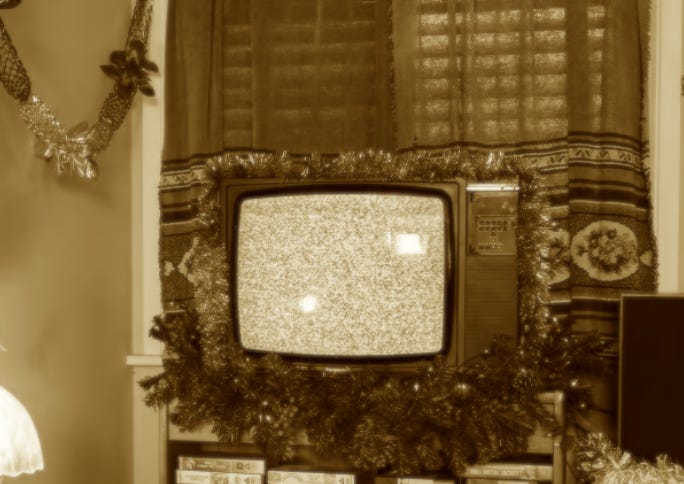
But the sight that met Scrooge’s eyes was no human shade. It was a box. A large rectangular box, big enough to keep a cat in, supported on metal legs. Below it was a thinner box, the size of a ledger. There were things like black snakes connecting the two boxes: and the larger box was hissing. Scrooge blinked in fear - for now he was truly fearful for his life - and saw that the hissing box was also somehow showing a kind of mist, a mist contained behind what Scrooge now saw was a glass screen. It was, thought Scrooge, as if the box was a trap for fog.
Just as this notion entered his mind, however, something happened. The fog turned into a photograph - how, Ebenezer Scrooge could not have said. The photograph was of a familiar scene: the street where he lived, and was so detailed that he could read the signs on the shops: and, even though it were only black and white and grey, like all photographs, he could almost see the green of the holly on an inn sign.
And then the figures in the picture began to move.
The carriage wheels turned, the snowball in an urchin’s hand hit its target - a beadle - and snow began to fall.
Scrooge let out a cry. He clapped a hand over his mouth then remembered the house was empty: no servants here at night, not with the wages being what they were.
And then he laughed: because he remembered the magic lantern shows of which his nephew was so fond. This was surely one of those, and someone - he had no idea who - was playing a trick on him.
“Very well!” cried Scrooge at the box. “Entertain me!”
As if heeding his request, three words appeared -
A CHRISTMAS CAROL
- only to be replaced a few seconds later with more words -
BASED ON THE NOVEL BY CHARLES DICKENS
Scrooge frowned. He knew nothing of Christmas Carols and less of Charles Dickens, whoever he might be.
Now the magic lantern show began in earnest. Behind the glass screen, he saw the inside of a counting-house, much like his own. A clerk, much like his own, was being admonished by an older man. Scrooge nodded in agreement as the older man propounded the virtues of thrift and hard work - and gasped when the younger man nodded sadly and said:
“But it’s Christmas, Mister Scrooge!”
The older man’s reply was lost to Ebenezer Scrooge: for at that moment realisation swept over him like a black cloud. What he was watching was no mere trivial magic lantern show but his own life, presented as a play with moving pictures. The older man was he, Ebenezer Scrooge, and the younger presumably his clerk, Bob Cratchit.
“This is witchcraft!” cried Scrooge. “What’s more, it is also lies!”
For the story unfolding in front of his eyes was not an honest account of Scrooge’s actions. What Scrooge considered common sense and frugality was presented on the screen as lack of Christian charity, while his good advice to Cratchit was twisted into miserliness.
Scrooge watched as once more he was visited by Jacob Marley, and once more he was warned of his three visitors. And then - o monstrous horror of horrors! - the scene changed without so much as a curtain being drawn, and he saw a young boy sitting alone in an empty classroom: and the boy was Scrooge: and his mother was dead.
“No!” cried Scrooge, but the scenes changed, and changed again. Now he was with old Fezziwig, his kind employer: now he was dancing with Alice, who had loved him and whom he he had loved: and now he neglected Alice as he devoted himself instead to gold and avarice.
“Lies! All lies!” muttered Scrooge.
As if they were listening, the pictures dancing in front of Scrooge’s eyes froze into a new image - Marley lying on his death bed, alone and unmourned.
“Not my fault…” Scrooge mumbled as once more he fell into slumber.
Time passed: seconds or minutes or even hours, it was impossible to tell. Scrooge was woken again. Music was playing, loud, raucous music.
Scrooge feared to open his eyes but the brightness in the room forced him to, and when he did, he saw upon the screen a wondrous sight. There, once again, was a picture, but this time the picture was made of colours - festive greens and reds, twinkling sapphire and diamond, glinting gold and shining silver, all of which emanated from a jolly, red-faced man on a throne of pies, turkeys and cakes. It was a Christmas scene to beat all Christmas scenes - or would have been without the hunched, mean-faced figure in a night-gown who stood scowling at the jolly giant in front of him.
“That’s me, I suppose,” said Scrooge to himself, and the moment he spoke, once again the figures began to move. Now the scene was the sparsely-furnished home of what Scrooge supposed was meant to be that of Cratchit, his clerk. A feast was being prepared – a feast of miniature proportions, to be sure, but a feast nevertheless. The Cratchit family were warm, and loving, and to Scrooge’s surprise – for he could not see how people who had nothing could be content – happy. And when their son, Tim, clearly ill and walking on crutches, piped up with a “Merry Christmas, everybody!”, Scrooge was shocked to feel for the first time in many years a tear upon his cheek.
He watched in disbelief as Cratchit insisted his family drink a toast to him – to Ebenezer Scrooge – despite Mrs Cratchit’s objections. And then – before he could wonder how he had never even thought of asking after Bob Cratchit’s family – the scene changed once more. Once again he was at a Christmas dinner, this time more sumptuous – once again a toast to his health was proposed, this time by his nephew, for whom Scrooge had never done anything – and once again a member of the company objected.
“Do you intend to show me every insult heaped upon me at Christmas?” Scrooge asked the screen. But answer came there none, for Scrooge was alone in the dark.
He remembered that one more video would be shown to him this night. He wondered – he dared hope – that it might show young Tim restored to health. He resolved to visit his critics and show them his better nature. He tried to remember if he had a better nature.
And then there came the familiar clunk.
The screen hissed at Scrooge: it sounded reproachful. He sat on the end of the bed and watched as the dancing snowflakes on the screen was abruptly replaced by a vision of real snow; this was however not a festive white carpet, but a grim bleak layer of whiteness on such a landscape that Scrooge had never seen before. It seemed to him that he was looking at a battlefield, or similar wasteland. The sky was the colour of smoke, the ground was grey and, where the sufficiency of the snow was not enough to cover all, certain things were visible. Broken metal in abundance, wrecked carriages of some kind, and most horrible of all, twisted skeletons whose pose suggested an agonizing death.
“What is this place?” asked Scrooge in terror and amazement. “Screen, what vision of hell is this?”
Once more movement came to the screen. Now Scrooge saw a group of figures in rags, picking up scraps of metal and cloth and dropping them into a cart with half its wheels missing. To his great surprise, he found he recognized them: though grown to adulthood, and grimier than the worst slum urchin, they were the children of Bob Cratchit. The girls had their mother’s blue eyes, the boys their father’s red hair.
“Look,” one said, indicating a large pipe, big enough to stand up in, “We can make camp here for the night.” And with determination and caution, they manoeuvred their scant possessions and themselves into the pipe.
Soon they had started a small fire. Scrooge observed the Cratchits. They were tired, their faces lined, and they looked as if they had lived through horrors. His heart, dormant for so long, ached for them.
“But where is - ” he began, then fell back to silence as the youngest boy spoke.
“Tell us a story, Belinda” he said.
“Which one?” his sister replied.
“Tell us the story.”
She smiled, wanly, and said:
“Are you sure, Peter? You’ve heard it a thousand times.”
“And I want to hear it a thousand and one times,” said her brother. “Please! It is Christmas Eve!”
“All right,” she said. “Once there was a world, and the world was good and it was bad. And the bad was always at the throat of the good. Evil attacked goodness, meanness struck at charity, and cruelty fought kindness.
“The bravest fighter for kindness was a man called Robert Cratchit - ”
She paused so her brothers and sisters could say, “Our dad!”
“ – and he fought for kindness as long as he could. But he was brought down by two things. One was the death of his beloved child Tim.”
Scrooge gasped.
“No!” he cried.
“And one was the relentless, inexorable, creeping meanness and cruelty of a man called Ebenezer Scrooge.”
“Lies!” cried Scrooge. “I was always - ”
He stopped. What he was always he could not say, but it could not be that he was good.
Belinda continued.
“And so, Robert Cratchit stopped fighting,” she said. “The likes of Scrooge won. And the world, starved of goodness and kind actions, ground to a halt. It became a charnel house, a world of death.”
She looked at her brothers and sisters.
“We try to look to the light,” she said, “But it is a guttering candle.”
“No!” Scrooge whispered. “I did not do this! I was not cruel, I was merely frugal! This is – it is - ”
He stopped.
“It is all true,” he said.
His eyes closed. He fell asleep.
Ebenezer Scrooge, man of business, miser, and skinflint, was woken by daylight and the sound of bells. He screwed up his eyes and jammed his fingers into his ears, but the light and the sound persisted. At last he was compelled to rise from his bed.
“Such dreams,” he said, “Such terrors.”
Then he felt himself suffused with a new sensation. It was hope, it was love, it was truth.
“No,” he said. “They were not dreams.”
He strode to the window, pulled back the curtains of sackcloth and let the light in. Outside, it was snowing, and men and women walked while children made snowballs or pulled makeshift sleighs. Scrooge waited for a song to begin, but realized that the song was already happening.
He threw open the window. A boy was standing below.
“You, boy!” Scrooge cried.
The boy looked up.
“Yes sir?” he asked.
Scrooge leaned out of the window.
“Do you know what a video is?”
The boy frowned.
“No, sir!” he replied.
Scrooge laughed. It was a rusty laugh, from somewhere inside him that he had rarely had cause to visit.
“Then fetch me a turkey!” he ordered. “The largest you can find.”
“Who can this be, on Christmas morning?” asked Mrs. Cratchit.
Her husband opened the door. Outside, in the falling snow, holding something in his arms like a bundle of washing, and wearing the first smile Bob Cratchit had ever seen on that face, was his employer.
Bob was so surprised and fearful that he almost shut the door in his face.
“’Tis Mister Scrooge,” he managed to say.
“What?” exclaimed his wife. “Does he want you to work on Christmas Day as well? Is he your employer or your overseer?”
Before Bob Cratchit could reply, Scrooge stepped forward. He was wearing a hat, and he raised it.
“Dear Mrs Cratchit,” he said. “I am not here to impose. I merely wished to bring you a gift.”
And from under a cloth he produced the biggest turkey that she – or indeed anyone – had ever seen.
When she was able to speak again, Mrs Cratchit said:
“Well… you’d better come in then.”
Christmas dinner at the Cratchits was the merriest of affairs. Pete sang, Belinda danced, Bob told jokes, and even Tiny Tim – to whom, the Cratchits noted with delight, Mister Scrooge showed the fondest regard – rose from his seat to recite a poem about a robin. And after dinner when the children were abed, Scrooge helped them put the presents under the tree: which was only fair as he had brought most of them.
Scrooge sat by the fire with Bob Cratchit.
“Tomorrow,” he declared, “I shall raise your wages to five shillings a week.”
“I think you’ve had too much punch,” declared Bob.
“No, Bob, I’m serious. I have turned over a - ”
Scrooge stopped. Beside the hearth was a large object. In the firelight it was hard to see what it was.
Bob Cratchit saw his employer’s expression and took it for curiosity.
“I see you’re looking at our mystery gift,” he said.
Answer came there none from Scrooge.
“I found it on the doorstep like a foundling,” Bob went on. “Blessed if I know how it works.”
He filled Scrooge’s glass. Scrooge did not even notice, so intent was he on staring at the box.
“It’s called a… vee-cee-ar,” said Bob. “Perhaps you can help me set it up.”
He clinked his glass against his stricken employer’s.
“A merry Christmas to us all,” he said, “God bless us, every one!”
DAVID QUANTICK 2025